
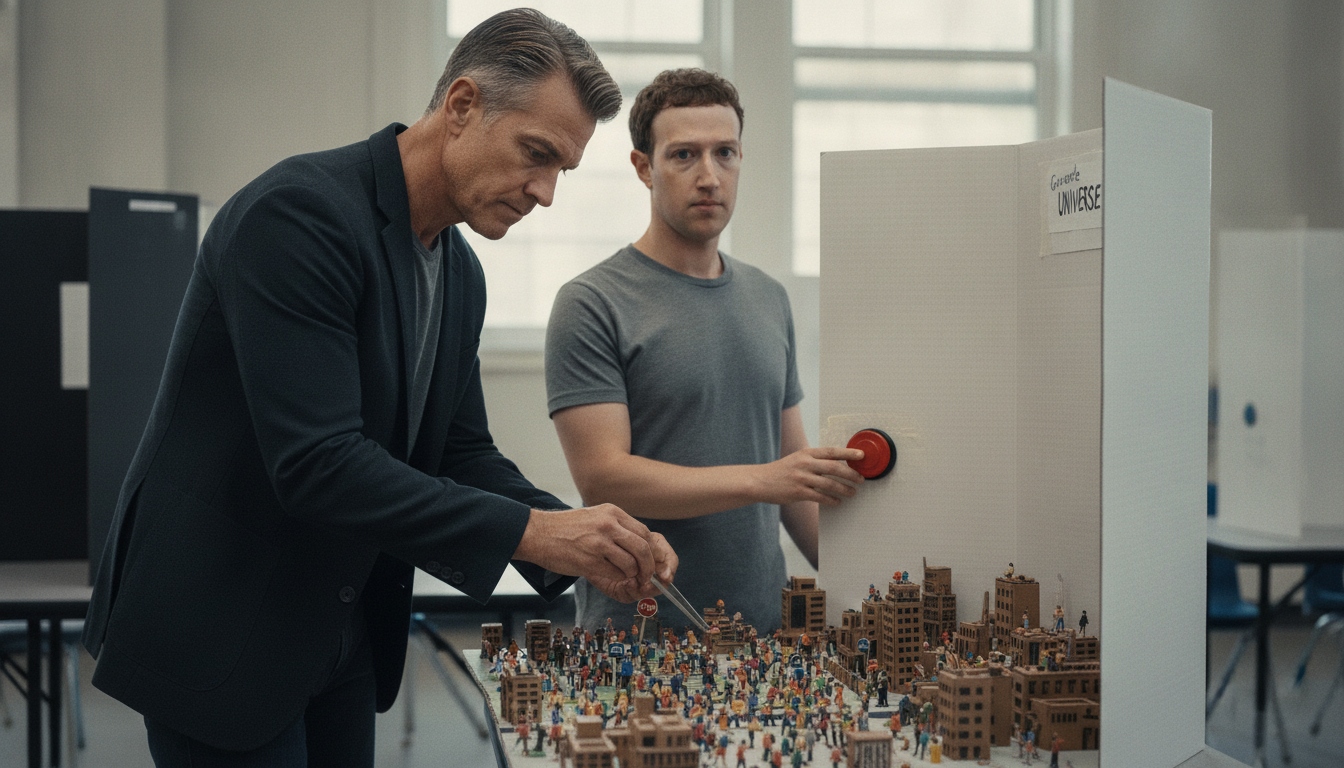
The hype was mathematically impossible to satisfy. Fans spent thirteen years waiting for the next installment of the most notorious crime-adventure franchise on earth. Expectations were entirely detached from reality. Rockstar Games delivered anyway.
We are standing at the exact intersection of two colliding universes. On one side, you have the absolute pinnacle of human inefficiency—a thirteen-year, blood-and-sweat grind that just produced the biggest entertainment launch in human history. On the other side, you have the dawn of an automated empire promising to eradicate that very grind forever. You are watching the end of an era and the birth of a new reality, happening on the exact same day.
The game launched as the highest-rated title of all time on Metacritic. It pulled in $3.79 billion on release day alone. That number makes the rest of the entertainment industry look like a lemonade stand. Avengers: Endgame tapped out at $2.9 billion. Taylor Swift’s Eras tour hit $2 billion. This single video game dwarfed them both.
The Three Billion Dollar Human Grind
Even the most relentless workaholics shut down their lives for this release. Startup founders completely reshuffled their workloads. Some were booking vitamin IV drips just to keep their energy up through the weekend. You do not see that level of physical commitment for a software update. You see it for a cultural earthquake.
Think about the sheer gravity of three point seven nine billion dollars in a single day. You do not achieve that by cutting corners. You do not achieve that by asking a machine to guess what people want. You achieve that by bleeding for the details. You achieve that by looking at a piece of digital architecture, deciding it is not good enough, and throwing away six months of work to do it right.
The Economics Of Obsession
Rockstar went the hard way. Five thousand people labored over this digital world for more than a decade. They built it entirely without generative AI. They hand-crafted thirty thousand different nonplayable characters. Every single one of those characters has a unique appearance. Every single one has a distinct personality. That is not efficiency. That is psychotic, unrelenting dedication to the craft.
The Eighty Billion Dollar Automation Engine
Then you look at Nasdaq headquarters. Anthropic executives are popping champagne. They just executed an $81.3 billion IPO. The makers of Claude just broke the record for the largest IPO ever. At the exact moment millions of players were wiping the dust off their consoles to step into Vice City, the tech industry was ringing the bell on a technology designed to make sure a game is never built that way again.
Efficiency is the north star of the artificial intelligence industry. The entire pitch is about expanding human capability by automating the heavy lifting. You stop wasting time tinkering with ideas that go nowhere. You feed a prompt into a large language model. The machine spits out a response. You move on.
That revolution has a dark side. We are watching children get buried under mind-numbing, synthetic slop on YouTube. We have lawyers citing fake, hallucinated cases in federal court. We have massive tech conglomerates like Meta firing tens of thousands of people under the banner of a corporate-branded Year of Efficiency. People are exhausted by the artificiality of it all.
The Paradox Of Masterpiece Inefficiency
Ben Feder used to run Take-Two Interactive. He looks at this landscape and sees the writing on the wall. He believes this is likely the last game of its kind to be made this way. We have reached the natural frontier of this specific development model. The era of throwing thousands of humans at a digital canvas for thirteen years is closing.
Masterpieces require deletion. Feder nailed this concept perfectly. You build something. It fails. You tear it down. You start over. Getting to a masterpiece requires an enormous amount of wasted effort. When you are building a world with this level of complexity, that deletion is violently expensive. It is the literal opposite of efficiency.
Investors hate inefficiency. They look at a thirteen-year development cycle and see a massive liability. They want the Anthropic model. They want the eighty-billion-dollar valuation built on instant generation. They want the push-button hit.
The Delusion Of The Push-Button Hit
Tech billionaires are selling a very specific fantasy. Mark Zuckerberg is on earnings calls promising that soon, an AI will understand you perfectly and generate personalized content just for you. Elon Musk takes it a step further. He claims you will not even have to ask. The AI will just figure out what video game you want to play and build it.
Strauss Zelnick runs Take-Two Interactive today. He hears that kind of talk and laughs. The idea that someone is going to push a button, generate a massive cultural hit, market it, and distribute it to millions of people is a joke to him. Entertainment has never worked that way. Human connection cannot be prompted into existence.
The Financial Market Reaction
The video game industry is already shaking. Google launched an AI tool earlier this year that lets users generate three-dimensional worlds just by typing prompts. Stock prices for traditional game developers took a hit. Investors are terrified about the future relevance of human developers. They see the writing on the wall, even if they do not understand the art.
Why We Crave The Mundane In A Synthetic World
This brings us to the ultimate paradox of this exact moment in history. We are living through a Grandthropic week. The game is captivating precisely because the developers had the runway to make mistakes. They experimented. They reworked ideas. They delayed the launch twice. The game was incubated in the exact inefficiencies that investors are paying Anthropic billions of dollars to eradicate.
Look at the actual gameplay. You wait more than three presidential terms for a high-octane action game. You download a 212-gigabyte behemoth. What are your first missions? You drive around doing errands. You put up drywall to make your girlfriend happy. You are forced to slow down.
That is either incredibly frustrating or absolute genius. In a world where AI is suffocating us with instant gratification, this game demands your patience. It reeks of humanity. Every tiny detail is loaded with human intention. That precision is what triggers a monocultural moment. We rarely get those anymore. Our media landscape is fractured by highly personalized social media algorithms.
The Final Frontier Of Handcrafted Empires
The ultimate fantasy here is not role-playing as a criminal. The real fantasy is relishing the mundane. It is exploring an expansive world that human beings were actually given the time and space to perfect. You are experiencing the final roar of a handcrafted empire.
Friction is exactly what makes art resonate. When you remove the struggle, you often remove the soul. We are entering an era where the creation of content will be nearly free. The cost of generating a landscape, a character, or a storyline is dropping to zero. When everything is effortless, effort becomes the ultimate luxury.
This is why players are wiping the dust off their consoles. They are feeling a sense of anticipatory nostalgia. They know they are participating in something that might never happen again. The economics of game development are shifting. The pressure to integrate generative AI into these massive projects will become insurmountable. The next time a studio sets out to build a world this large, the board of directors will demand they use AI to cut the timeline in half.
The contrast is absolute. On one side of the country, executives are ringing the Nasdaq bell to usher in the age of the prompt. On the other side, millions of people are driving virtual cars around a meticulously hand-crafted city, putting up digital drywall, and marveling at the fact that a human being took the time to put it there.